
and protection against injury
Toughened glass
Thanks to the toughening process, internal stress changes occur n the structure of the glass pane, resulting in an increase in mechanical strength and resistance to thermal shock. When broken, toughened glass breaks into small, indistinct pieces minimizing the risk of injury.
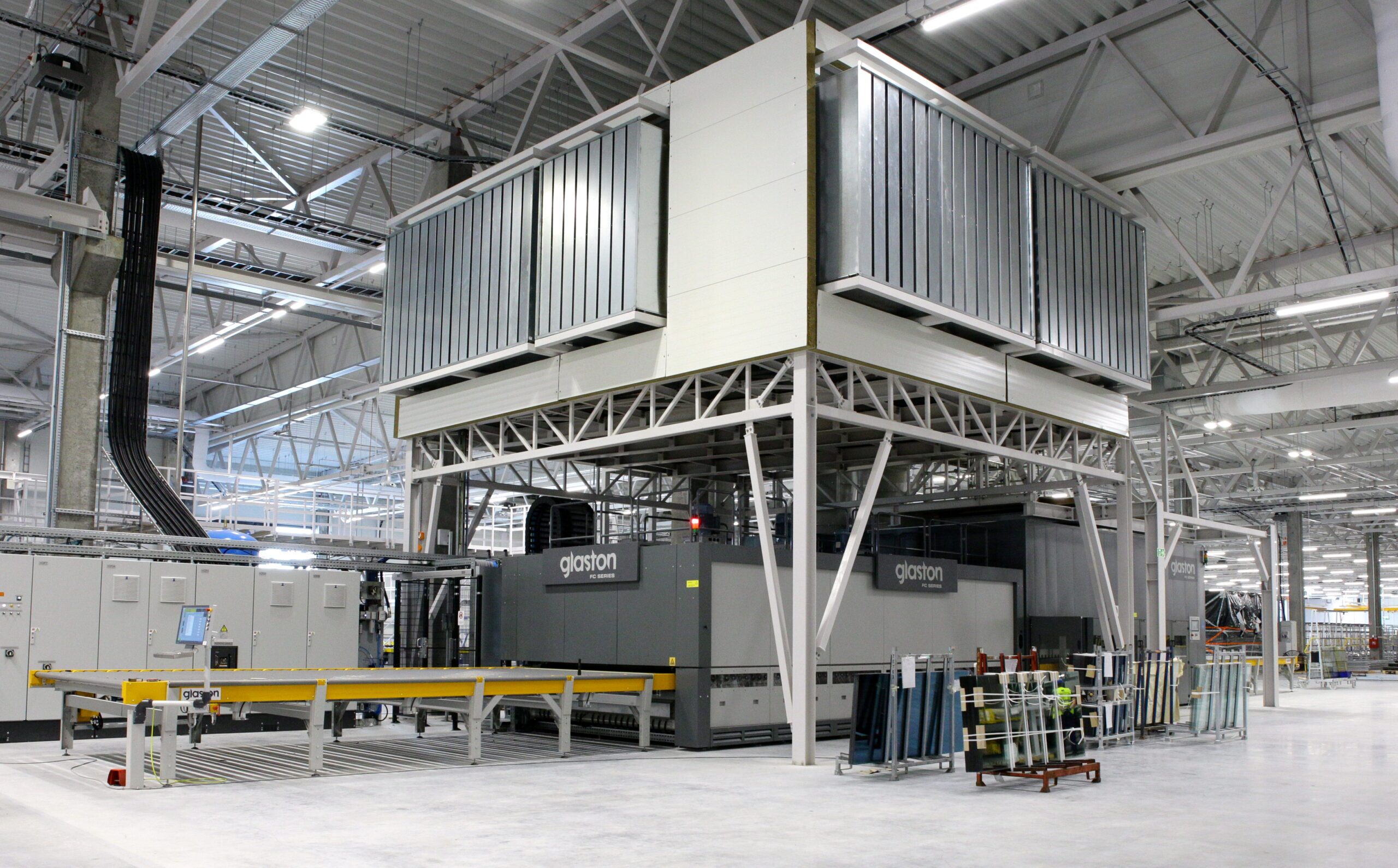
Glass toughening process
The process of toughening glass involves heating the glass panes to a temperature of about 620-680°C followed by rapid cooling with a stream of air. This action creates permanent stresses in the structure of the glass, which increase its resistance to impact and temperature changes. According to european standards and resulting calculations, it can be assumed that toughened glass is up to five times stronger than annealed glass of the same thickness.
Directional toughening
An inseparable component of the toughening process is the so-called glass waviness. PRESS GLASS informs all customers that this effect can occur, in order to be fair in service. The waviness effect is of particular importance if glass panes are assembled in building facades, especially with big glazed surfaces.
It is visualised by a distortion of the view reflected in the facade. To decrease the distortion effect of a reflected picture, it is suggested that directional toughening is made. It means that e.g. in the case of toughening along the height, waviness will occur perpendicularly to this dimension.
Heat strengthened glass (TVG)
Heat strengthened glass differs from the toughened glass by the kind of breaking netting, which occurs during glass panel damage. Due to its breaking characteristic, the panel assembled in the frame stays there after the damage, which protects against injury.
Heat strengthened glass is not counted among the types of safety glass.
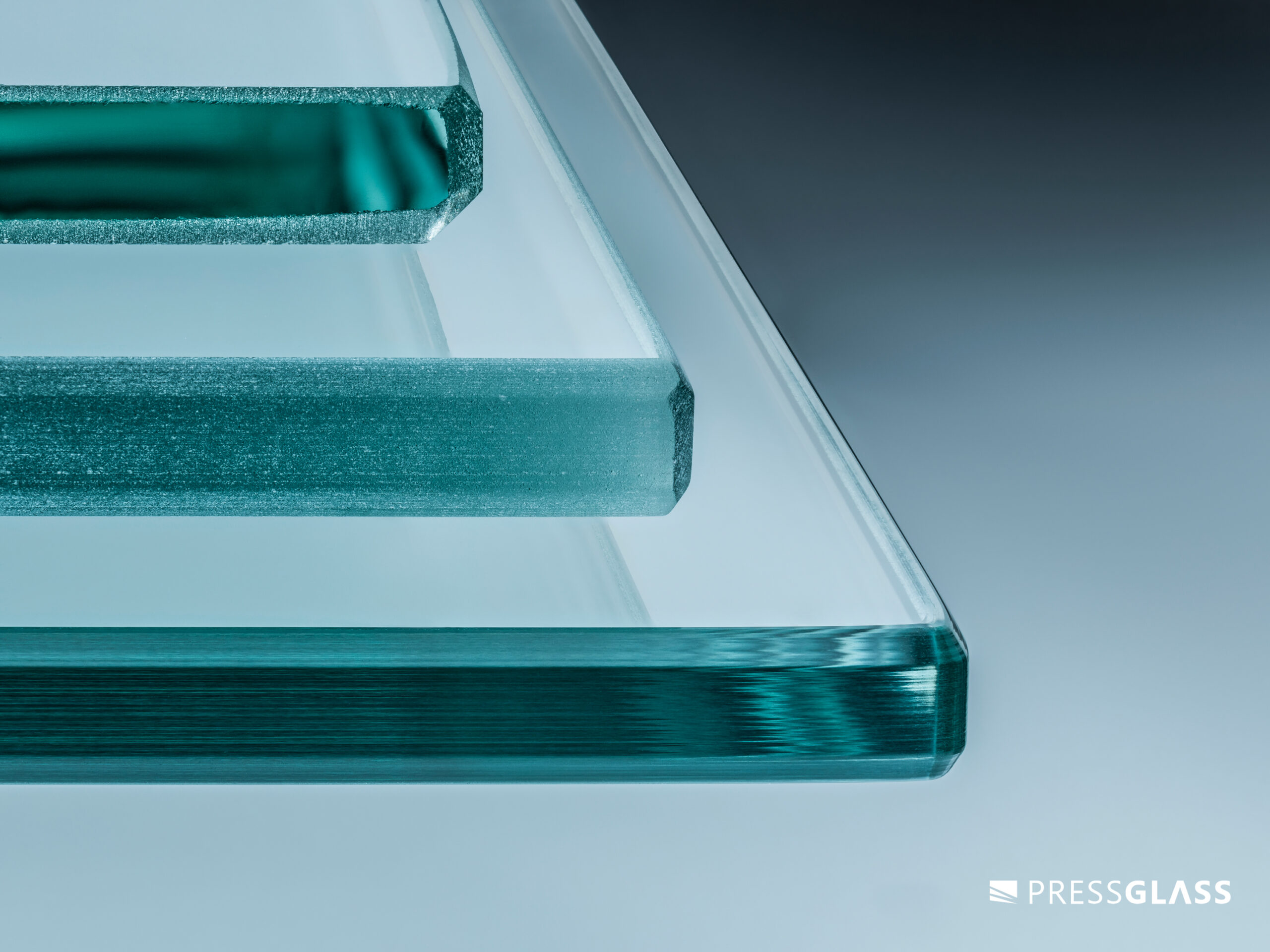
Edge processing
and the toughening process
Before the toughening process begins - depending on the requirements - the glass may undergo mechanical processing, i.e. cutting, drilling, grinding or grinding and polishing togehther. The toughened safety glass produced by PRESS GLASS cannot undergo further mechanical processing.
All requirements must be submitted together with the toughening order. If there is no additional information, all toughened panes up to 8 mm thickness are produced by PRESS GLASS with arrised edges (this is included in the price). Glass panes which are thicker than 8 mm have matt ground edges (grinding is not included in the price and should be added to the price of tempered glass).
Benefits and applications
of toughened glass
Benefits
- Protection from injury in case of breakage
- Increased bending strength
- Increased resistance to thermal shock
Examples of applications
- Single glazing and insulated glass units, both single and double-chambered
- Glass with drillings or cuttings
- Glass with arrised, ground or polished edges
- Glass with shapes of rectangles, polygons, arcs etc.
- Silicone-coated and enamelled glass
- Silk-screen printed glass
Specifications
| Type of toughening | Glass thickness [mm]. | Min. dimensions [mm]. | Max. dimensions [mm] T-thermofloat |
| Standard | 4 | 100 × 250 | 1700 × 2500 (T: 1500 × 2500) |
| 5 | 100 × 250 | 2000 × 3000 (C: 2000 × 3000) | |
| 6-19 | 100 × 250 | 3200 x 7000 |
| Glass thickness [mm] T-Thermofloat |
Min. dimensions [mm]. | Max. dimensions [mm] T-Thermofloat |
| 4 | 200 × 450 | 1700 × 2500 (T: 1500 × 2500) |
| 5 | 200 × 450 | 2000 × 3000 (T: 2000 × 3000) |
| 6-12 (T: 6-10) | 200 × 450 | 3200 x 7000 |